


Don’t Manage Talent by Remote Control
Leaders of portfolio districts agree that schools should be more autonomous and accountable, and that teachers should be judged and rewarded on the basis of performance. Those principles can be complementary, but the actions taken in pursuit of them are sometimes in conflict. In particular, state-mandated teacher evaluation systems can undermine school autonomy. We know […]
Doing No Harm
One of the key arguments of charter school opponents is that charter schools hurt the kids left behind in district-run schools. It is true that as families choose charter schools, district enrollment, and therefore funding, shrinks. But what happens next is up to the districts. If districts choose to preserve expensive central offices and cost […]
New York City Compact Threatened: New Mayor’s Proposed Policies Could Set Back Efforts to Improve District-Charter Collaboration and Equity
NYC’s mayor-elect Bill de Blasio has proposed a moratorium on co-location of district and charter schools and is considering charging rent to at least some charter schools that use city facilities. These moves may threaten both the hard-won relationship between district and charter schools and the well-documented gains in student achievement during the Bloomberg administration. […]
Truth in Advertising in the Portfolio Strategy
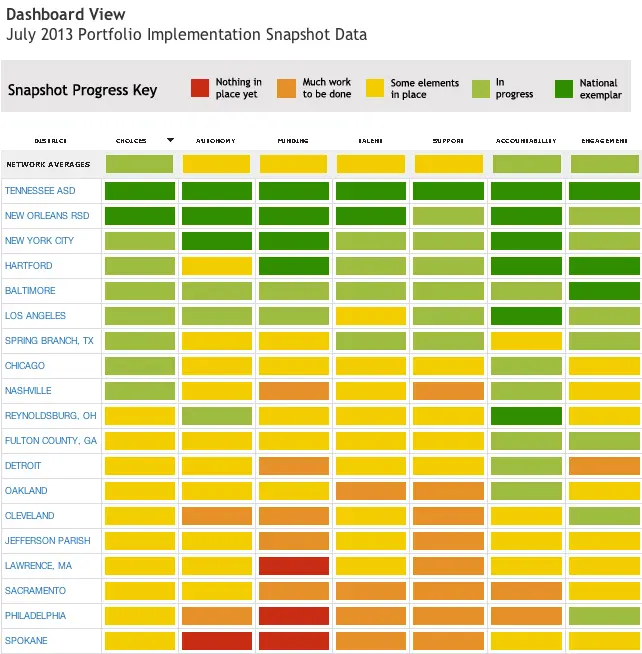
Portfolio cities are not all created equal. Some, like New Orleans, have been able to advance quickly. Others are slowed down by the public reactions to school closures or school board turnover or other political or technical realities. District leaders like the idea of accountability for schools, but avoid creating clear performance criteria. They like […]
Mobilizing Parents to Support Governance Reform
Last week, three cities pursuing portfolio strategies held elections. In Denver, voters kept a pro-reform majority on the school board. In Boston, a strong pro-reform mayoral candidate lost, but to a man who serves on a charter school board and favors continued charter expansion. In New York, the mayoralty was won by a candidate who […]
Reinventing Public Education Must Be About Problem Solving, Not Ideology
When Paul Hill wrote CRPE’s treatise, Reinventing Public Education, nearly 20 years ago, he was taking off on an idea developed by David Osborne and Ted Gaebler in Reinventing Government: the role of government should be to steer, not to row. It should get out of the business of central planning and instead unleash innovation, […]
City Spotlight: Boston
In Boston, 128 district schools, 16 charter operators, and 22 Catholic schools are represented in their Collaboration Compact. Under this agreement, the three sectors have joined forces to figure out how to best implement the Common Core State Standards, share and develop effective instructional practices via school-to-school partnerships, better align the student enrollment process, deepen […]
John Deasy and the Impossible Job
A few years ago I sat with a group of urban district leaders in a noisy L.A. restaurant, leaning forward to hear every word from the new Los Angeles Unified School District superintendent, John Deasy. Deasy had, admirably, given up a comfortable job at the Bill & Melinda Gates Foundation to get back into the […]
Charter Schools and New York City Education Reform
New York City mayoral candidate Bill de Blasio has promised to reverse his predecessor’s policy of providing facilities rent-free to charter schools. His reasons? First, charter schools have financial advantages, including money from foundations. Second, teachers and principals in traditional public schools are annoyed by having to share facilities with charter schools. This proposal, and […]
Portfolio Governance Reforms: Why We Shouldn’t Wait
People who see the portfolio strategy as a threat and those who see it as an opportunity both want to know: What’s the evidence that it works? The concept is still relatively new, and it will take a while to build a robust evidence base. But that doesn’t mean that cities desperate for viable solutions […]