

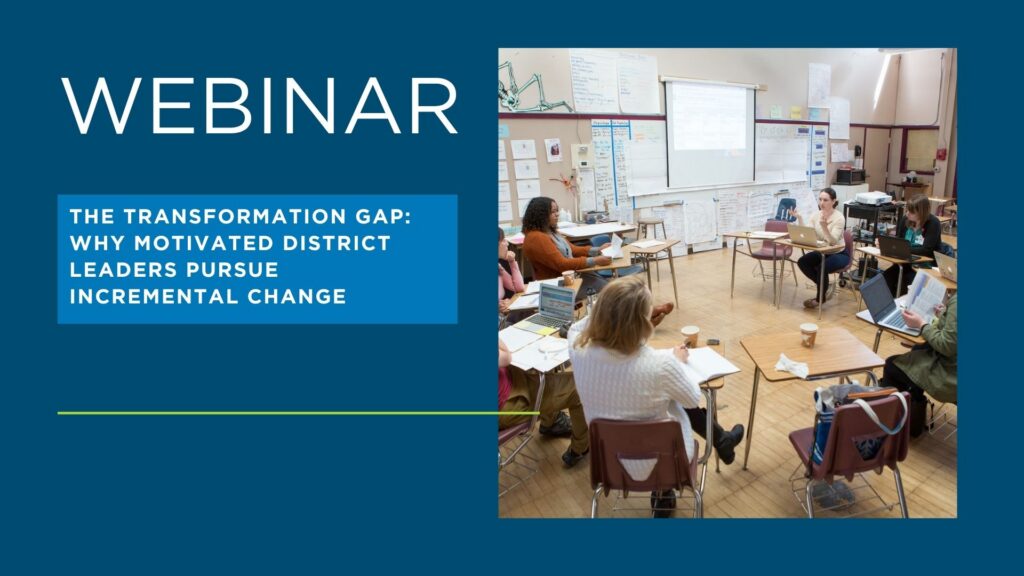
CRPE’s recent report, The Transformation Gap: Why Motivated District Leaders Pursue Incremental Change, sparked rich conversation during our webinar and panel discussion on August 5, 2026. The audience Q&A was robust, and we didn’t get to all of the great questions. We wanted to share the webinar recording for anyone who could not attend, as well as summarize the discussion and provide additional responses to the Q&A.
Panelists
Chelsea Waite, Principal – CRPE
Michael Berardino, Senior Research Analyst – CRPE
Jess Rose, Senior Program Officer, Education – Barr Foundation
Kathy Greider, Former Superintendent – Farmington Public Schools (CT)
Bill Kimball, Superintendent of Schools – Maple Run Unified School District (VT)
Questions from the Audience
Q: To what extent do you think these trends are specific to New England and/or common to leaders in smaller school districts, which predominate in New England? If specific to New England, what conditions or factors do you think are shaping superintendents’ approach relative to their peers in other regions?
A: We don’t have directly comparable survey data from outside New England. That said, within our regional sample, we found few consistent statistically significant differences in survey responses by district size or urbanicity. As for how New England compares nationally, CRPE studies districts across the country, and we see similar dynamics elsewhere. Few districts are pursuing transformational visions in ways that actually translate to changing students’ day-to-day experiences and outcomes systemically. Even districts with bold visions and capable leadership struggle to advance change efforts that genuinely redesign school systems as they are today. What may be more distinct to New England is the context shaping that pattern. In New England, we have a large number of small, town-based districts with strong local control, a dense ecosystem of intermediaries and technical assistance providers, and even, in some cases, shared superintendents across multiple boards. The regional dynamics may make it possible for a minority of districts with the right conditions to more nimbly pursue big changes, but they also make coordinated, widespread change more complex to pull off.
Q: In her latest book, Strong Ground, Brenè Brown spends a chapter on transformation. She makes a compelling case that genuine transformation involves a certain amount of deconstruction of the current system. How do you see deconstruction’s role in educational transformation? This question came up live and sparked one of our richest panel exchanges.
A: All three panelists agreed that deconstruction is core to transformation, not incidental to it. For example, Kathy Greider pointed to significant professional development and community engagement around grading and assessment in Farmington. This enabled the district to move from behavior- and completion-based grading to mastery-based grading tied to specific learning targets, and to de-level their humanities courses from three tracks down to an honors and a college-credit-bearing option. Bill Kimball described deconstructing traditional student leadership structures that had become more about resume-building than real influence. In Maple Run, he rebuilt a student advisory group with real authority. Jess Rose framed deconstruction as extending beyond systems to identity. Many educators’ sense of self is bound up in their role, which makes deconstruction feel threatening. Transformation requires leaders to create real space for unlearning and letting go, not just of old structures but of old ways of understanding their own role.
Q: The lack of exposure to innovation resonates. Ed reform has not really arrived in most of New England! What networks exist to begin to expand superintendents’ exposure to innovations that show promise in other parts of the country?
A: We heard about this kind of exposure happening through several channels, though it tends to be leader-driven rather than systematized. In interviews, superintendents pointed to state and national superintendent associations, funder-backed networks, and nonprofit technical assistance providers as key sources of new ideas. On the panel, Kathy Greider described how being part of Lauren Resnick’s Principles of Learning work through the University of Pittsburgh, and exposure to thinkers like Richard Elmore and Michael Fullan, shaped her orientation toward transformation. Bill Kimball described a deliberate personal habit of seeking new ideas from outside the education sector. Jess Rose described the Barr Foundation’s approach of connecting a cohort of New England districts with technical assistance partners so they can learn together rather than build this capacity alone. There is no single directory of networks to point you to, nor common district-wide strategies to expose leaders and educators to new ideas and ways of working, and that gap is itself part of what we found.
Q: I’m curious about whether the authors saw a pattern in how ideas about transformational change played out for districts that had already done vision-setting and alignment work, as Kathy and Bill are describing (Vision of the Global Citizen/Portrait of a Graduate/Learner, etc.), and used that vision to drive and reflect on their decisions and work?
A: Our 47 interviews were purposively sampled specifically because these districts had public evidence of a redefined purpose, such as a Portrait of a Graduate, a Vision of the Global Citizen, or a particularly ambitious strategic plan. Among these, we saw real variation in how far that vision translated into redesign. Some districts, like Farmington under Kathy, aligned hiring, budget, grading, and course structures to the vision over the course of a few years and treated it as a genuine North Star. In other cases, the vision outpaced implementation, changes provoked resistance from powerful stakeholders even with a community-endorsed vision in place, or districts had to course-correct when initial change efforts created unintended consequences. In short, having a Portrait of a Graduate or similar vision document was not, on its own, a reliable predictor of long-term transformational change; what mattered more was whether leaders used the vision to actively realign every system around it and sustained that alignment through leadership transitions.
Our survey didn’t measure how many districts in the broader regional sample had a similar strategic vision in place. Other research suggests such a vision is necessary to redesign school systems, but our study shows clearly that it’s not sufficient.
Q: It seems like the Superintendents on the panel both model their own version of “systems change” independently / individually. Could Board members establish an “accountability measure” that tracks individual “systems change”? In other words, could there be certain types of “education” and “mindsets” formally expected and established by Board members? This question was addressed live during the webinar.
A: The panel’s view leans toward boards using their goal-setting and inquiry role to reinforce a systems-change orientation, more than toward certifying individual mindsets formally. Kathy Greider described a reciprocal relationship where the board stayed a ‘policy board’ and she, supported by an explicit board policy naming her role as district CEO, was expected to bring the vision to life. The board held her accountable by asking clarifying questions and expecting to see the vision reflected consistently across budget, hiring, and communications. Bill Kimball agreed, describing the board-superintendent relationship as a continual ‘learning edge’ worked out in practice rather than fully specified in advance. Jess Rose’s answer got closest to a formal mechanism. She said boards can send strong signals about what’s valued through the pace and number of goals they set (one or two multi-year goals versus a new one every year) and by regularly asking superintendents what they’re learning, rather than requesting a constant stream of new data. So all three were optimistic that boards can play this role, though less through a formal accountability rubric and more through the questions they ask and the goals they set. Although the panel didn’t discuss hiring, one implication of CRPE’s research is that boards can signal explicit expectations during superintendent search and hiring processes, and screen candidates not just for effective management skills, but for training and experience with change leadership. That includes advanced political skills to build coalitions toward a new vision for schooling.
Q: How do you “unlock demand”? Meaning, how do you get your community to know what they don’t know in order for them to ask for a fundamentally different grammar of schooling?
A: We didn’t hear it phrased in quite these terms, but the clearest answer in our research is shared exposure. In interviews, the superintendents who expanded what their communities believed was possible were the ones who got skeptical stakeholders physically out to see a fundamentally different model in action; one leader told us those visits left people ‘changed, absolutely changed,’ and that visitors then helped spread the word themselves. This often means not just educators, but mayors, town council members, school board members, and ‘naysayers’. This is very much the dynamic Jess Rose named when she talked about the ‘grammar of schooling’ being so entrenched that people are blind to the systems they’re in, until they see something radically different.
On the panel, Kathy Greider and Bill Kimball both described a related strategy: having students present the case for change directly to the community, because students turned out to be highly credible messengers for why a change like de-leveling courses or shifting to mastery-based grading actually benefited them. So demand doesn’t usually get unlocked by explaining a new model, but more often by letting the right people see or hear about it directly from a credible source.
Q: Just wondering what you think (based on results of your survey and interviews) a superintendent who is more typical of your respondents would say about the conversation you all just had?
A: This question gets at the core tension our research revealed. Based on our findings, we’d expect most superintendents to agree with Bill, Kathy, and Jess that changing school districts is difficult, necessary work. After all, 98% of surveyed leaders told us they feel personally motivated toward transformational change (as they understand it themselves).
But we’d also expect widely ranging views on:
- What districts should reasonably aim to achieve. Nearly all superintendents agree that achievement and instruction must improve. Fewer—between one and two-thirds—are aiming for their districts to eliminate outcome disparities, dramatically expand postsecondary pathways, and develop durable skills.
- What degree and depth of change is required. Some superintendents told us that their most ambitious change efforts were ensuring quality core instruction. Far fewer aimed to redesign what students learn, de-level courses, and change how adults and students relate to each other.
- What changes are actually feasible. Superintendents hearing the panel conversation might agree broadly with the ideas shared. But when it comes to what they can actually imagine, prioritize, and push forward in their day-to-day jobs, the picture is different.
A typical respondent might listen and feel affirmed that their work matters, but also feel that the deep redesign work panelists described is aspirational — and possibly not even critically necessary. The harder conversations we hope to have, going forward, are about what new knowledge and leadership development can help more leaders develop the will and skill to transform school systems, as well as how policymakers, communities, school boards, and funders can help shift the role and expectations for superintendents so that leading transformation is their central charge, not a nice-to-have.