

More students than ever are being identified for special education. CRPE invites you to explore why using our new Unlocking Potential Data Center.
In early 2025, the National Center on Education Statistics reported a record 7.9 million public school students identified with disabilities under IDEA. This continues a decades-long rise in students placed in special education programs—programs meant to bridge the gap between what students need to succeed and what their regular classrooms can typically provide.
Unlike other federal education programs, special education is structured as an entitlement: eligible students gain rights and services, and schools gain obligations to provide them. That structure was designed to provide families with some semblance of power in a system where families rarely feel powerful. But it has also increased demand for special education services, since eligibility is often the difference between students securing some help (even if it is inadequate) and no help at all.
Federal law limits eligibility to students whose struggles stem from “innate” differences—such as dyslexia, autism, or ADHD—rather than poverty, language barriers, or poor instruction. Yet identification rates vary dramatically by state, suggesting that where a student lives may matter more than what they need.
Explanations abound for why more students than ever are being identified as having a disability. Some experts suggest that increased awareness of conditions like ADHD has reduced stigma and increased demand for special education. Others point to the impact of the pandemic, which delayed evaluations and increased students’ need for support, causing a spike over the last few years. But neither of these explanations helps us understand perhaps the most confounding feature of special education in the U.S.: how it varies dramatically across states.
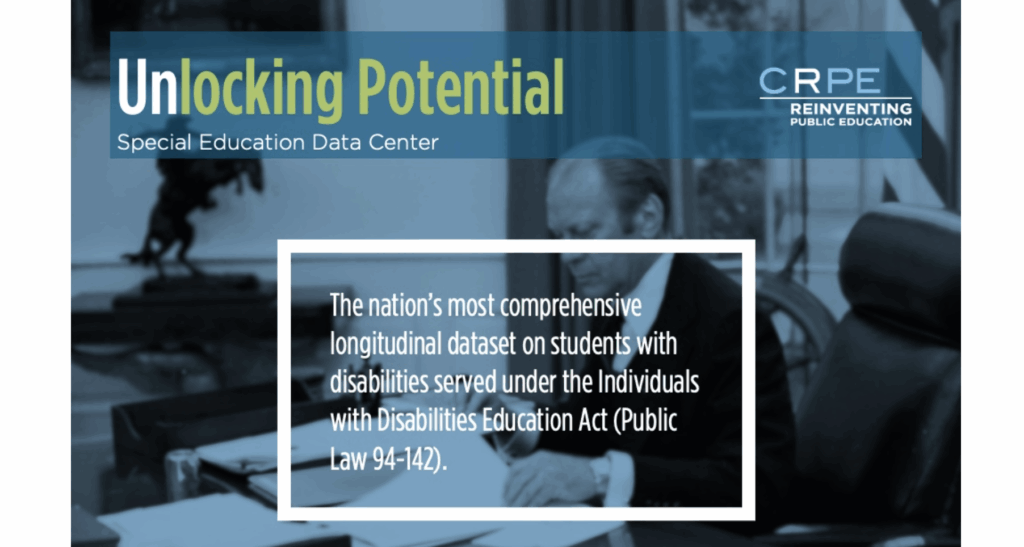
CRPE’s new Unlocking Potential Data Center provides the nation’s only cross-state, longitudinal record of special education identification rates. The data raise critical questions about fairness and consistency in how eligibility is determined. CRPE invites individuals and organizations to participate in our DataSprint, using the Unlocking Potential Data Center to explore a critical question: Why are more students being identified for special education?
Submission Details
The 2025 Unlocking Potential DataSprint invites contributions that address the following question: Why are more students being identified for special education? Submissions must:
- Include a written (no more than 1,500 words), data-based answer to the focal question that includes (a) a rationale for the inquiry, (b) a brief description of the data and analysis used, and (c) a brief description of findings and implications.
- Make use of the Unlocking Potential Data Center (additional data are welcome, but not required).
Up to five submissions will receive a $10,000 stipend to continue their work and publish with CRPE.
We especially encourage analyses that examine how policy conditions—such as state funding formulas or accountability systems—shape identification rates and their consequences for students. For example, a submission might explore the relationship between state finance formulas for special education and differences in identification rates across states. A submission in this vein would describe (a) why special education finance formulas might contribute to differences in identification rates, (b) the data and methods the contributor used to explore this line of inquiry, and (c) the conclusions suggested by this exploration.
Submit your entry using the form below by November 14, 2025.
Additional crosstabs data is also available for download here.