


This piece is a follow-up to this blog, published last year.
AI is present in classrooms more than ever before, partly due to tech companies’ provision of professional learning for teachers and partly due to school districts’ large-scale purchases of AI software. Beyond helping educators save time and enhance student learning, AI has also given them a new field to teach: AI literacy. Educators must instruct students on how to understand, use, evaluate, and reflect on AI technologies. In this way, education is unique from every other industry. Instead of just grappling with how to use AI effectively and responsibly, schools must also determine how to teach effective and responsible use.
School district communication with families about appropriate AI use is in its early stages. A spring 2025 survey by the Center for Applied Research in Education (CARE) at the University of Southern California shows little difference between responses from this year and those from last. Parent awareness of school policies about AI remains low, and their opinions about appropriate student AI use in classrooms remain mixed. A concerning pattern has also emerged, with students from higher-income families disproportionately more likely to use and be exposed to AI.
Parents are getting little to no communication about AI from schools.
Leveraging the probability-based and nationally representative Understanding America Study survey panel, CARE found that 96% of families with an elementary-aged child either did not know about any school-communicated AI policy or explicitly said their school has not communicated anything. Secondary schools are communicating a bit more, though 83% of families reported schools have either not communicated AI policies or the responding parent did not know if they had. Further, nearly half of surveyed parents didn’t know whether teachers were prohibiting or encouraging student AI use at all. Only about 1 in 10 parents of middle and high school-aged teens reported that teachers are encouraging students’ AI use in school. These numbers have barely changed since CARE first asked these questions a year ago.
Wealthier teens have more exposure to AI and use the technology more often.
Multiple sources have estimated that about a quarter of teens have used AI for school work, including Pew’s survey of teens and the CARE survey of parents (31%). Teens with access to AI, who are exposed to its capabilities and learn how to leverage its power responsibly, will be at an advantage when it comes to college and career.
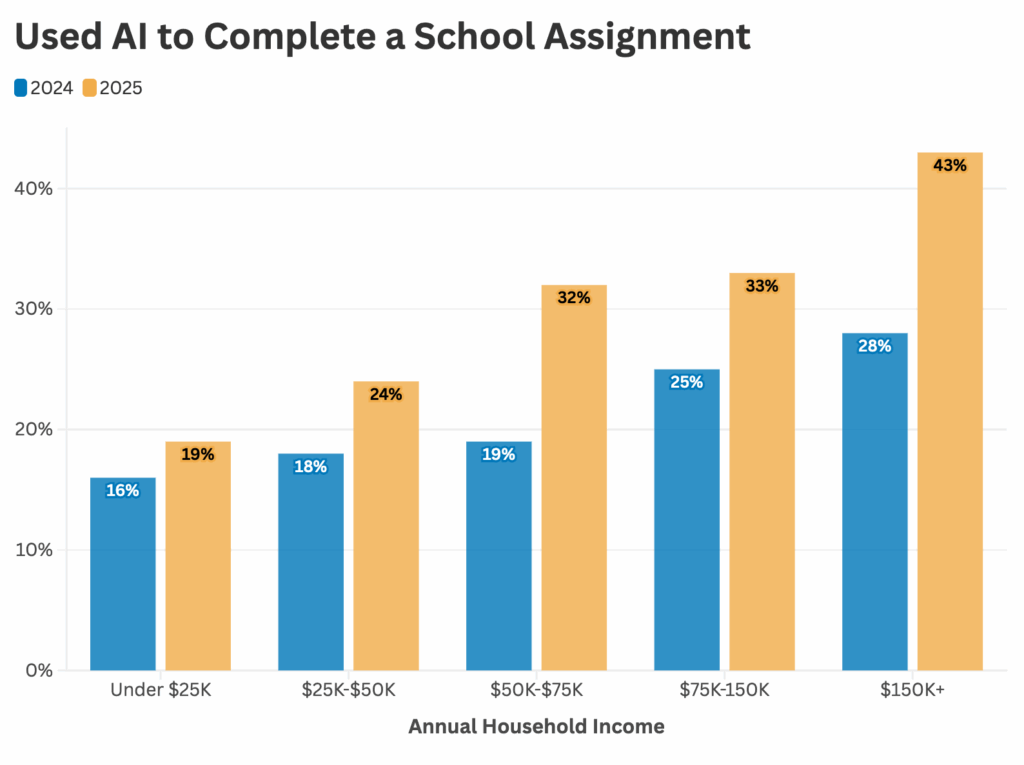
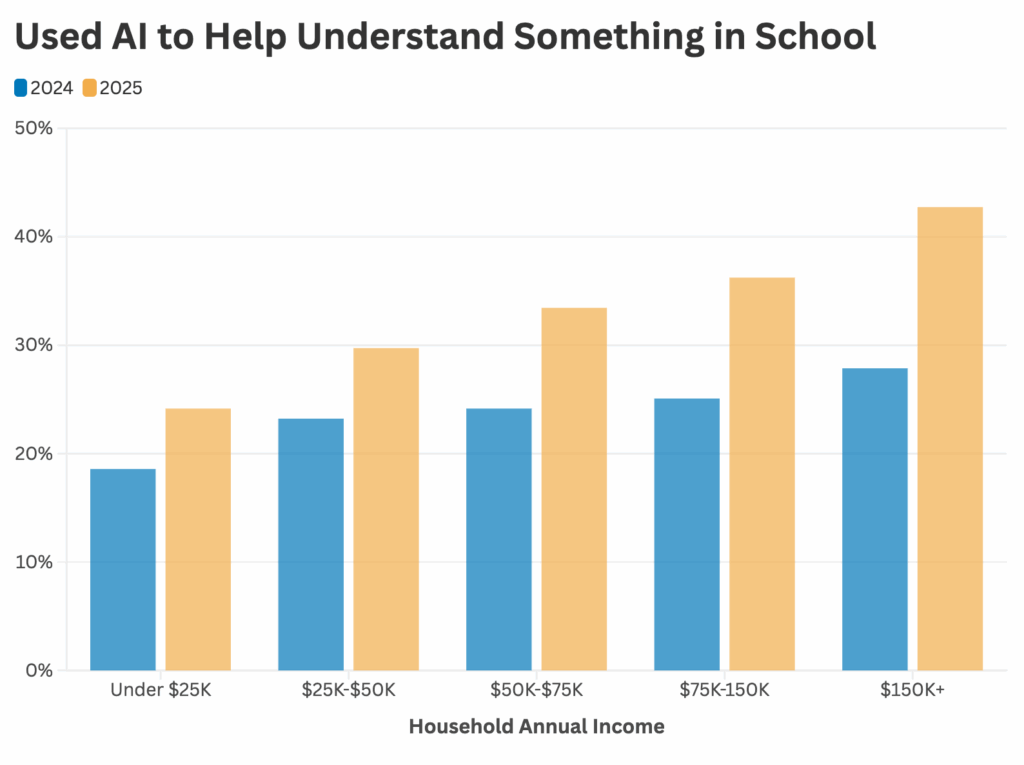
But not all students have the same opportunity to learn about and use AI. CARE’s survey found that almost half of the highest-income families reported teenagers’ AI use. Over 40% of the highest-income parents said teens had used AI for school; 46% said they had used AI to learn something. Just 19% of the lowest-income families report their teens using AI for school, and only 26% said teens had used AI to learn something.
Clearly, the economic disparity in AI use is growing. In 2025, the gap between teens from high-income families and those from low-income families reached 24 percentage points, double the 12-point gap observed in 2024. These findings mirror patterns in school district support for training teachers, and AI-related educator professional development is more common in low-poverty districts than high-poverty districts.
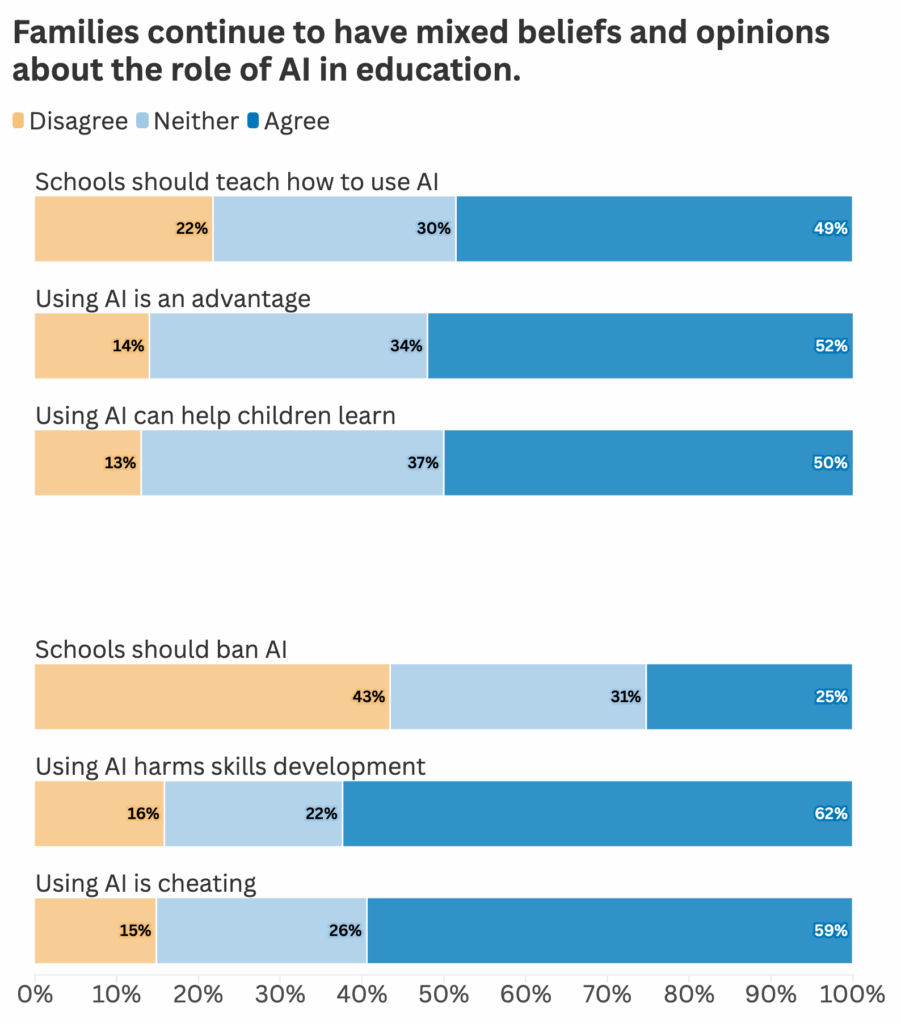
Families continue to have mixed beliefs and opinions about the role of AI in education.
AI is changing many aspects of adults’ personal and economic lives, so it is not surprising that parents don’t know what to think about AI in classrooms. The CARE survey showed parent opinions about the role of schools in teaching students about AI remain mixed and essentially have not changed over the last year. Between a quarter and a third of reporting families decline to take a position on AI, including whether using AI is cheating, if schools should ban it, or whether it helps children learn. While half believe schools should be teaching students how to use AI, 25% think schools should completely ban it. Nearly two-thirds believe that using AI will undermine children’s basic skill development, though 50% believe that AI can help their children learn. It seems some families have internalized AI’s potential benefits and others its potential harms, while still others see both the risks and the rewards, possibly feeling torn between the two.
Advancements in AI capabilities will likely shape the future of the workforce and life in general. Today’s students need to understand AI’s risks and pitfalls, as well as how to use the technology responsibly. Parents, for their part, need to learn about school and district policies and practices for supporting student AI literacy. Economic inequities in student AI access and use need to be leveled out in the classroom. If current trends hold, the gap between haves and have-nots will only grow. State and district leaders must address these gaps by putting forth clear AI policies and supporting high-quality teacher training on AI use.