


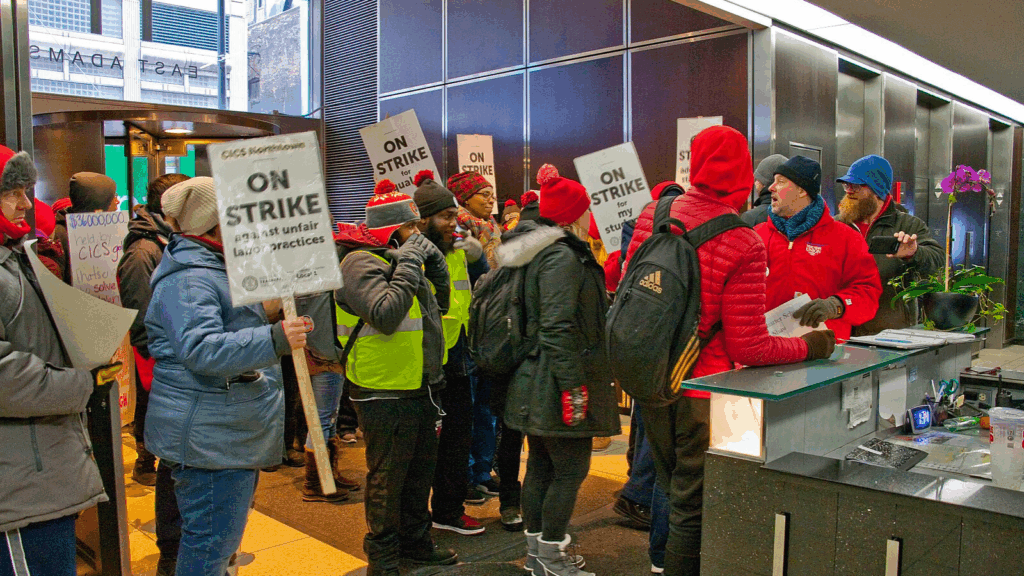
Public school districts are facing an existential threat. Demographic shifts and school choice policies are exacerbating declining enrollment. A diminishing role for the federal Department of Education alongside broad economic uncertainty could further erode state and local revenues. These trends threaten student outcomes and teacher jobs, as well as district solvency. When we talk about improving public education under these conditions, it is disingenuous (and unproductive) to ignore the role of teachers’ unions.
Today, unions’ traditional and legitimate focus on “bringing home the bacon” for their members is in tension with their need to avoid destroying the enterprise that employs them. Right now, schools need flexibility to stem enrollment losses and attend to post-pandemic learning gaps. They must adopt (and train teachers to use) new, evidence-based curriculum to analyze and act on student assessment results, consider new approaches to team-based staffing models, use technologies like AI to help teachers individualize student academic support, and fill critical holes left by federal cuts to student counseling and social services. Public schools can’t meet these needs when their budgets are tied up in union wage demands backed up by strike threats.
If their militancy and aggressive demands continue, unions and districts could be entering a death spiral in which unaffordable labor settlements and work stoppages exacerbate district decline.
But this fate is not inevitable. Unions can protect their members’ interests while also considering the health of the industry in which they work. To do so, teachers’ unions must adapt to working within a threatened industry (like the United Auto Workers (UAW) did in the 1970s) by changing their strategy from a mostly adversarial relationship with employers to one that is demanding but tempered by realism.
This is a long way from teachers’ unions’ current position. During and after the pandemic, they have pressed for hiring more teachers, dramatically raising salaries, and more support from nonprofits and social service agencies. In many cities (Chicago, Seattle, Oakland), this has led to crushing deficits. Unions have hounded out superintendents who, faced with insolvency, have proposed spending cuts and school closings. In some cities, it is clear the unions pay no attention to district budget limitations, insisting that the state government should pony up.
Unlike the UAW, which had to acknowledge the bedrock fact of declining auto sales, teacher unions tell their members that political mobilization can scare the state government into coming up with a lot more money. But union leaders who want to avoid killing the school systems that employ their members have other options. They can:
- Stop threatening strikes for wage settlements that will throw their host districts into deep debt.
- Allow differentiated pay, including higher levels to attract and keep quality math, science, and special ed teachers, and higher pay for hard-to-staff schools. These changes would improve schools, stabilize staffing, and address real equity problems. They don’t threaten membership numbers and would enable better STEM and special education instruction.
- Stop fighting charters and other public alternatives to private choice; it’s a losing battle. Unions should help the public sector compete, and chartering is a necessary part of that strategy.
- Concede on sustainable public pension reform and accept flexible benefit packages that let teachers with different needs set their own priorities (e.g., employer-paid health insurance coverage for those who need it, other benefits like child care support for those whose spouses’ jobs provide health insurance for the whole family).
- Lead the charge to transform high schools to be more career-relevant and use out-of-school time for tutoring, career counseling, etc. This will mean allowing industry and higher education experts who are not regular district employees to serve as teachers of record.
- Lead the charge for evidence-based instruction. This will mean a national campaign to end the math and literacy wars, give struggling students adequate targeted support, and get objective, solid evidence on good instruction to state and district leaders. It may also mean supporting and designing state accountability systems to sanction schools where students don’t learn due to the persistence of pseudoscience-based practices.
- Give teachers in schools more say on how vacancies are filled. This includes eliminating seniority placement preferences, which force new teachers into the most troubled schools where they can face overwhelming problems and get little help.
At a time when federal regulation and funding are withering, states and localities face loss of financial support but have unprecedented freedom of action, as CRPE has previously documented.
States have a responsibility to act in the best interest of students and protect their districts against financial insolvency. Legislators could prevent disastrous collective bargaining agreements by limiting pay package increases to a few percentage points above inflation or by capping salary increases for districts that are losing students and whose teacher-to-pupil ratio is growing. States could also preserve school flexibility by limiting collective bargaining to teacher compensation and benefits, ruling out district concessions on issues like curriculum, teacher assignment, class size, and last-in, first-out reductions in force.
State officials can also press both unions and school boards to make realistic bargains by publishing definitive information about district incomes and expenses. If necessary, states should invalidate labor agreements that districts can’t afford, though the extent to which they can do so may depend on whether they’re right-to-work states, etc.
In their own interests, teacher unions need to change. The singular pursuit of maximizing teacher pay and benefits regardless of consequences will lead to disaster for the unions, as well as for the families that depend on local public schools. In the event that unions don’t deviate from the path of confrontation, state and local elected officials need to take action to protect district solvency and the quality of schooling.