


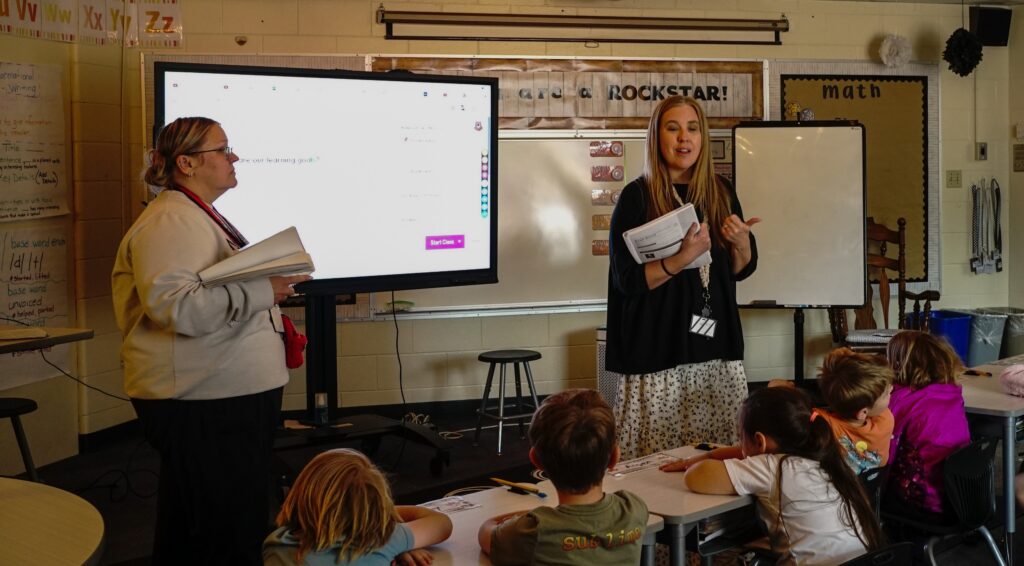
The traditional American classroom has looked the same for a century: one teacher, one room, one roster. Critics have long argued that this model leaves teachers isolated, overburdened, and with limited opportunities for specialization, collaboration, or career growth. In response, school systems across the country are experimenting with new ways to organize teachers via strategic school staffing models. One of the fastest-growing initiatives is the Next Education Workforce™ model, developed at Arizona State University. In this team-based staffing model, a small group of educators shares responsibility for one larger group of students instead of each teacher working in isolation. Our research team looked at what happened when one large, diverse Arizona district rolled out the Next Education Workforce model across its schools over several years. The strongest takeaway: teaming can improve student outcomes—we find clear gains in middle school math—but we can’t measure an effect in other contexts. Teaming is also consistently linked to lower teacher turnover and higher teacher evaluation ratings. Our headline findings:
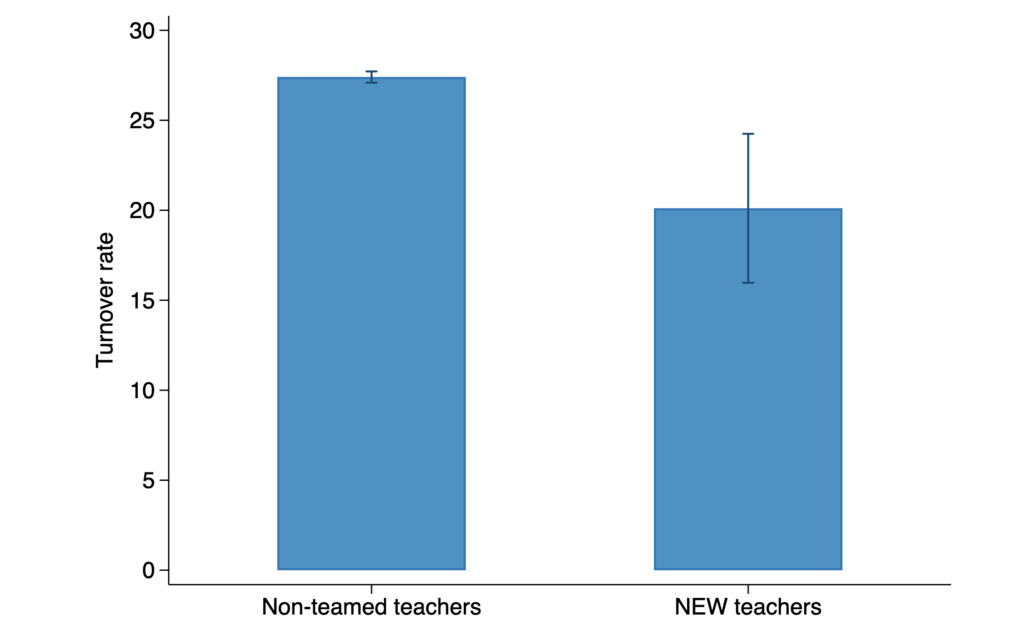
- Teachers working on teams stayed in their schools longer and earned higher evaluation ratings than their peers. These patterns showed up across all grade levels.
- On average, we could not measure an effect of teaming on student test scores—positive or negative—across the district as a whole. While we were able to rule out a large, across-the-board impact, that doesn’t mean teaming had no effect at all. Rather, in most grades and subjects, our analysis couldn’t separate teaming’s effect from other things changing at the same time.
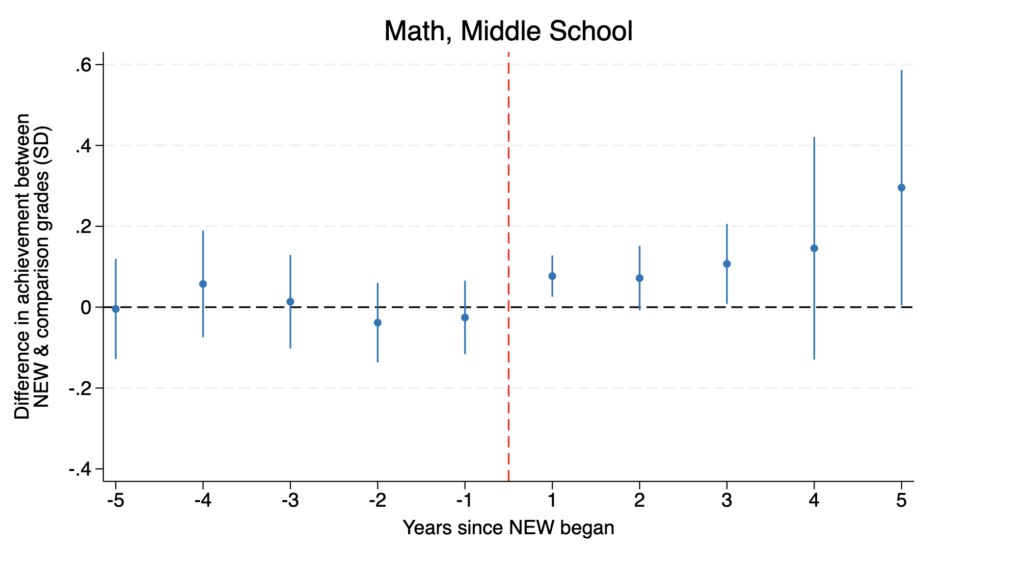
- But there was one clear, consistent exception: middle school math. In these grades, teaming raised achievement by a meaningful amount, with strong evidence across multiple tests and models.
Below, we’ll walk through what the Next Education Workforce is, what we did, what we found, and what it means for leaders deciding whether and how to adopt team-based models.
What Is the Next Education Workforce?
Team-based models reenvision what the teaching profession looks like by changing the traditional one-teacher, one-classroom model. In the Next Education Workforce model, which we often refer to as “teaming,” 2-6 educators (licensed teachers, paraprofessionals, teacher candidates, or other staff) work as a team and share a single, larger roster of students. The idea is that teams can divide up roles according to each educator’s strengths, plan together, and support one another, easing the load on any one teacher while also improving the student experience by allowing for more personalized and responsive learning environments.
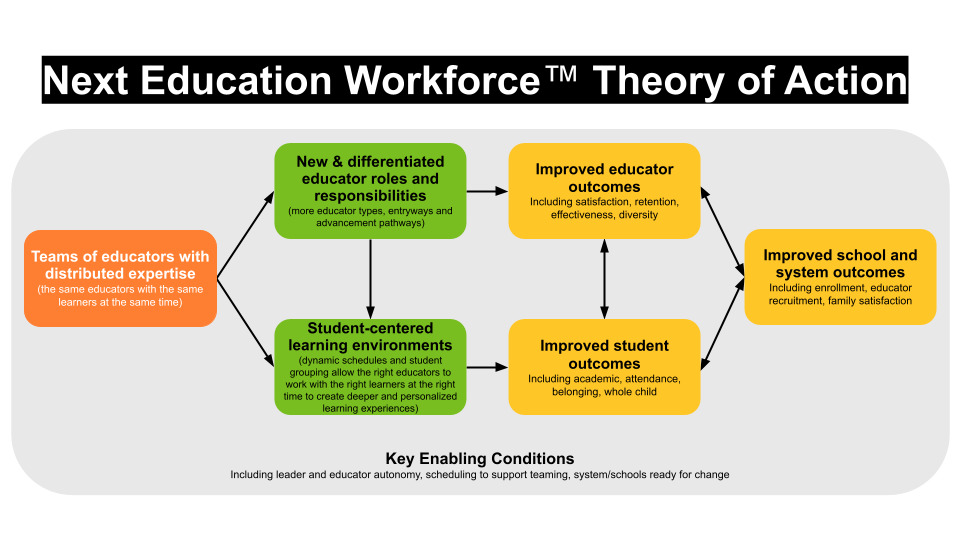
NEW is also a flexible framework, not a rigid program. Each school principal decides how to build their teams, and schools adapt the model to their own needs. In our study, teaming covers a wide range of practices, from shared planning time to full co-teaching, and no two schools look exactly alike.
What We Did
We studied teaming in one large Arizona district over five school years. Because the district phased the Next Education Workforce model in gradually across different schools, grades, and subjects in different years, we could compare grades that adopted teaming to similar, traditionally staffed grades that hadn’t yet adopted the model. We track how each grade’s outcomes developed before and after teaming began in a difference-in-differences framework. This allowed us to estimate the causal effect of teaming in a way that simple before-and-after or cross-grade comparisons cannot (see the full paper for more details on our methodology).
What We Found
Teachers: Lower Turnover and Stronger Evaluation Ratings
As we’ve found in earlier work, teaming is still strongly associated with improvements in teacher outcomes. Teamed teachers were about seven percentage points less likely to leave their school the following year. This is a sizable improvement, given that the district has around a 27% annual turnover rate. Teamed teachers also earned significantly higher classroom evaluation ratings than their non-teamed peers, suggesting teaming may be associated with improved instructional practice. These teacher benefits also showed up fairly evenly across grade levels, including in elementary grades, where we did not find achievement gains.
For system leaders wrestling with teacher shortages and burnout, these findings may point to a possible solution. But while retention and evaluation ratings may be reasons to value teaming in their own right, they can’t explain the improvements in middle school students’ performance.
Student Achievement: No Measurable Effects Overall, but With One Bright Spot
Across the district as a whole, teaming did not meaningfully change test scores in a way we can cleanly measure. However, the overall average hides important differences across grades and subjects. In particular, teaming improved student achievement in middle school math by about 0.08 standard deviations. That translates to roughly 2-3 months of additional learning, or moving a student from a typical teacher’s classroom to a classroom led by a teacher who is a better instructor than about 70% of their peers. This result is consistent across multiple statistical models and data decisions, which is why we treat it as our most credible finding. We also see suggestive evidence that these gains grow over time, but our estimates aren’t precise enough to say so confidently.
Results in elementary grades and in ELA were much less consistent and much more sensitive to how we set up our analysis, so we can’t draw firm conclusions on the causal impacts of NEW in these cases. We’ve still included the elementary and ELA results in the report for transparency, but we interpreted them with caution.
Why middle school math?
Although our data can’t tell us exactly what happens inside teamed classrooms, the pattern we find is consistent with prior research: team-based staffing appears most promising when it increases collaboration between teachers without disrupting established teacher-student relationships. School structure is likely a key factor. In most elementary schools, one teacher covers all core subjects for the same group of students all day. Layering teaming onto that structure might introduce specialization, which could change teacher-student relationships and require additional coordination across teachers. Prior research on departmentalization at the elementary level (where students move between teachers specializing in particular subjects) suggests that the downsides can cancel out the benefits.
However, middle schools are a different environment. They’re often already departmentalized, so teaming likely doesn’t change teacher-student relationships in the same way. If anything, teaming probably adds what traditional departmentalized settings often lack: structured collaboration and shared responsibility among different educators. There’s strong evidence that teacher collaboration improves student outcomes, so it’s unsurprising that the clearest gains show up in middle schools, where teaming likely increases collaboration without changing the level of specialization. This interpretation fits both our results and the broader literature, but confirming it would require more detailed data on how teams operate—a priority for future work.
What We Still Don’t Know
There are some key limitations to this research.
- Our data is limited. We focus specifically on grades 3-8 because we have student achievement data for these grades, even though teaming also happened from Pre-K through high school. Teaming likely impacts other student outcomes we might care about, including students’ engagement and sense of belonging.
- We can’t yet determine exactly what caused the middle school math result. We tested several possible explanations, including improvements in student attendance, differences in gains across students, and differences in teacher outcomes, but none of them explained the result. Something real is happening in those middle school math classrooms, but our data can’t yet tell us what.
- We still can’t see inside the “black box” of teaming. We know which grades adopted Next Education Workforce models, but not the depth or quality of the teaming students actually experienced, which can vary widely.
- These are early results. For many grades, we only observed a short window after teaming was adopted. Our results can be interpreted as early signs of success, and we plan to conduct more research on the long-term impacts of the model.
What This Means for Practice
For district and school leaders weighing whether or not to implement team-based staffing, a few practical implications follow from this evidence.
- Don’t expect uniform test-score gains. Teaming did not raise achievement across the board, especially in the early years. In middle school math, the largest gains were seen four and five years after initial implementation. Leaders should set realistic expectations and plan to sustain the model long enough to learn whether it is working for their students.
- Fit the model to the setting. The clearest academic gains appeared in middle school grades, where students already move from classroom to classroom by subject. In elementary grades, where teaming would replace strong, self-contained relationships, proceed thoughtfully and watch for potential downsides.
- Teacher retention and practice may justify teaming on their own. Even without evidence of consistent test score gains, keeping more teachers in their schools and supporting better teaching practices are outcomes worth valuing, particularly given high levels of educator burnout.
- Implementation depth likely matters. Because teaming spans a wide range of practices, how faithfully and deeply a school implements the model is likely central to whether it works. We plan to dig deeper into understanding differences in implementation and how they relate to outcomes.
Why does this matter?
Nationally, student performance and engagement continue to decline while teacher burnout increases, and districts are searching for answers. No model will fix everything, and NEW is not an exception. Our results are a case in point: we find real gains in middle school math, which is notable given how rarely interventions move the needle on achievement at all, but we cannot measure student impacts elsewhere. So far, the most consistent benefits are for teachers, and there is strong evidence that these benefits also matter for students. The task now is to better understand where and how these models deliver, so districts can build on what works to continue improving student outcomes instead of guessing how to support teachers and students.
Methodology Notes
This blog summarizes a working paper by Mary Laski, Calen Clifton, and Dan Goldhaber. The full paper, including complete methodology, is available here. Support for this work was provided by the Overdeck Family Foundation and Tandem Philanthropies.