


Fiscal crises are no longer the exception for school districts; they’re the new normal. This report examines how 14 districts and charter networks cut costs while protecting student learning experiences. The report draws on case studies commissioned with colleagues from Afton Partners, Education Resource Strategies, and New Solutions K12, and is accompanied by four in-depth case studies: Rapides Parish Schools, Acton-Boxborough Regional School District, Lubbock Independent School District, and Uplift Education.
The top takeaway: Make sure your political strategy is as smart as your financial strategy. The leaders who kept their communities’ trust through painful budget decisions didn’t treat politics as a problem to manage after the numbers were final; they built it into the process from day one.
other Key takeaways
- Start with what you will preserve. Before naming a single cut, effective leaders named what was off the table—the classroom experience, facility quality, staff retention—so families and staff weren’t left guessing.
- Be upfront about the size, root causes, and urgency of the budget crisis, as well as the inevitability of cuts. Districts that shared real forecasts and enrollment data early made it harder for later cuts to look arbitrary or avoidable.
- Ask not just, “Does it work?” but, “Is it worth it?” Leaders paired outcome data with cost data to run real return-on-investment analyses, sunsetting low-value programs, and defending high-value ones with evidence.
- Mix one-time cuts with cuts that permanently remove recurring costs. “Low-hanging fruit” like discretionary contracts weren’t enough on their own. Districts also had to tackle structural costs like staffing and facilities to close the gap for good.
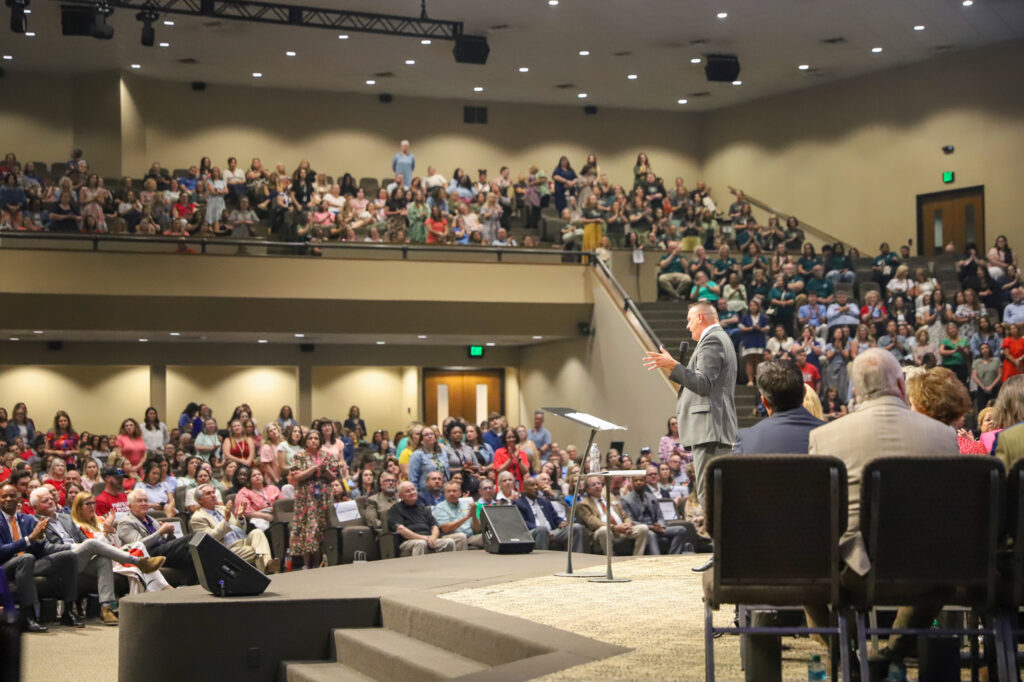
- Keep constituent interests front-of-mind when deciding among cost-cutting strategies. Listening tours, public meetings, and outreach beyond the “usual suspects” helped leaders understand what mattered most before decisions were finalized.
- Be ready to compromise, not abandon the effort. Pushback was treated as a signal to adjust scope or timing, not a reason to scrap a plan. This happened through buyouts, transition support, or reinvesting savings into what staff wanted most.
- Communicate with transparency throughout. Leaders got ahead of rumors, shared real numbers, and were honest about what wasn’t on the table, including unrealistic hopes for new state or federal funding.
- Expect a multi-year process. Budget fixes rarely hold for more than a year or two, financially or politically. The districts that succeeded treated this as ongoing work, not a one-time fix.
Financial sustainability is now an ongoing responsibility, not an occasional crisis to manage. District leaders can no longer hand budgets off to finance staff and just review the results after the fact. Fiscal pressure is constant, so the political management has to be constant as well.
Explore the report and case studies below.
case studies
Axton-Boxborough Regional School District - Acton, MA
In a relatively affluent community, residents didn’t believe budget pressures were serious until district leaders built a public planning committee and asked them to balance the budget themselves. The exercise built the case for staff reductions and a school closure that stuck.
Lubbock Independent School District - Lubbock, TX
Facing enrollment declines and new state accountability rules, Lubbock ISD leaders ran a rigorous return-on-investment analysis of their career and technical education pathways, using labor-market data to decide which programs to keep, expand, or sunset.
Rapides Parish Public Schools - Alexandria, LA
After a failed attempt to consolidate schools, Rapides Parish leaders tried again, this time engaging the community early and often. The new plan won broad support, and within a year the district saw measurable financial and academic results.
Uplift Education - Dallas-Forth Worth, TX
Despite balanced budgets on paper, this charter network faced a persistent $30 million structural shortfall. Large-scale staffing changes, philanthropic fundraising, and a new performance-pay model bought short-term relief but didn’t solve the underlying gap.